
Public Info
EERI-SEAOSD San Diego Earthquake Planning Scenario
https://sandiego.eeri.org/2014-eq-scenario/
Scenario Study for a Magnitude 6.9 Earthquake on the Rose Canyon Fault for Earthquake Risk Assessment and Reduction in the San Diego Region
Overview
The Rose Canyon Fault Zone runs through the heart of the San Diego metropolitan area, presenting a major seismic hazard to the San Diego region, the third largest and one of the fastest growing population centers in California. The region’s large population coupled with the poor seismic resistance of its older buildings and infrastructure systems, make San Diego highly vulnerable to earthquakes.
Over five years culminating with the 2020 report publication, experts in geoscience, engineering, and emergency management studied the impacts of a magnitude 6.9 scenario earthquake on the Rose Canyon Fault Zone (RCFZ) to raise awareness and prompt action towards reducing risk to earthquakes. The outcome of this report is a vision for a Seismically Resilient San Diego and an outline of next steps to improve the San Diego region’s earthquake resilience.
SEAOSD collaborated with the EERI San Diego led scenario project team and led the Working Group 2 – Buildings and Lifeline Infrastructure assessments. Working Group 2 was co-chaired Anthony Court SE (SEAOSD Past President) and Alvaro Celestino SE (SEAOSD Member) and was assisted by Matthew Martinez (SEAOSD Past President), Peter Maloney SE (SEAOSD Member), and the SEAOSD College of Fellows, among many others. The Working Group 2 team coordinated with Hope Seligson to develop the HAZUS loss estimation modeling, conducted a preliminary survey and inventory of the various highly vulnerable structural building types in San Diego, conducted initial reviews and facility operator interviews to assess the lifeline infrastructure vulnerabilities, and prepared the initial draft for the Buildings and Lifeline Infrastructure sections of the final report.
EERI Scenario Publications
Download the report and technical supplementary materials using the EERI links below. As future studies are conducted, more materials will become available on this page.
The Executive Summary document provides a concise 16-page summary of the key findings and recommendations and can be used as a powerful communication tool for Structural Engineers to highlight the Scenario study the severity of the local RCFZ seismic hazards to their clients.
Technical Supplements
Additional Resources
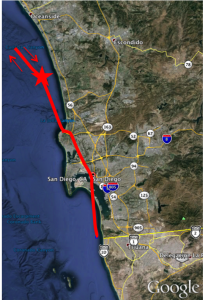
The Scenario earthquake is a M6.9 crustal strike-slip Rose Canyon Fault rupture with a length of 69km, slip of a maximum of 2m, and an epicenter depth of 7.7km.